Showing posts with label Cooking Basics. Show all posts

Sunday, September 13, 2026

Potatoes: How to Buy, Store, Handle Sprouts and Green Spots, and Cook Them Smarter

Potatoes look sturdy, but they are surprisingly sensitive to light, heat, moisture, and very cold storage. A bag that seems fine at the store can turn green, sprout, soften, or develop an odd sweet flavor if it sits in the wrong place at home.

The useful routine is simple: buy firm potatoes without large green areas or heavy sprouting, keep them dark and ventilated, wash them only when you are ready to cook, and be more cautious when a potato is extensively green, bitter, soft, or rotten. If you fry or roast potatoes, a few preparation choices can also reduce how much acrylamide forms during high-heat cooking.

Start with firm potatoes at the store

Choose potatoes that feel firm for their size and do not have wet, soft, or badly damaged areas. Utah State University Extension recommends smooth, firm potatoes without soft or green spots. A few harmless-looking surface marks are normal on a crop that grows in soil, but deep cuts, wet decay, extensive bruising, and obvious greening are reasons to choose another potato.

Look at the entire bag, not just the potatoes visible through the front. Light exposure encourages greening, so a clear bag that has spent a long time under bright store lighting can hide greener potatoes on one side. If a potato is already heavily sprouted at the store, leave it behind rather than planning to rescue it later.

Variety matters more for texture than for basic safety. Russets tend to cook up fluffy, while waxier red or yellow potatoes hold their shape better. For storage, however, condition matters first: a firm, intact potato will generally keep better than one that is bruised, cut, wet, or already soft.
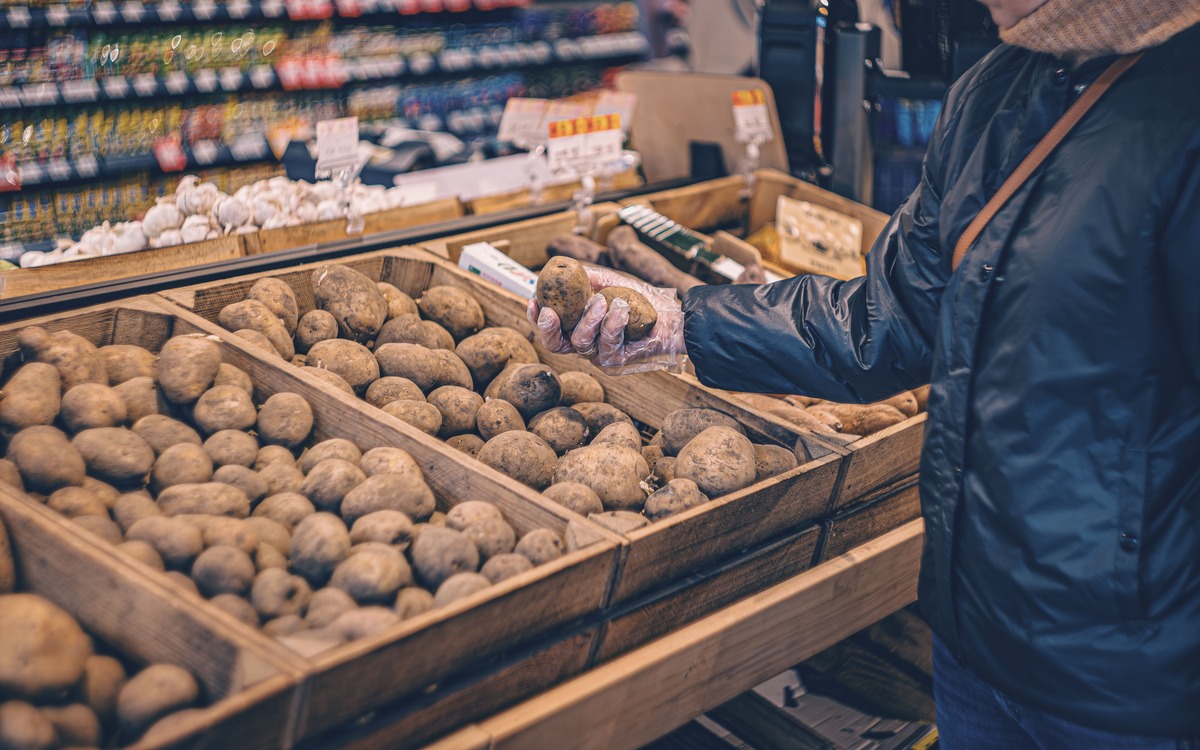
Shopper selecting firm potatoes from wooden produce bins in a grocery store

Store whole potatoes in a cool, dark, ventilated place

For most homes, the best storage spot is a dark pantry, cabinet, cellar shelf, or other cool place with some airflow. Utah State University Extension recommends a dark, cool location with air circulation and notes that paper bags or perforated plastic bags can help. Colorado State University Extension similarly recommends a well-ventilated, dry, dark, cool place.

Avoid sealing potatoes in an airtight container while they are raw and unpeeled. Trapped moisture makes spoilage more likely. A paper bag, open basket in a dark cupboard, or ventilated produce bag is usually more practical.

Do not wash potatoes before storage. Soil can be brushed off if needed, but added moisture shortens storage life. Wash and scrub them under running water shortly before you cook them.

Check stored potatoes every week or so. Remove any potato that becomes wet, moldy, badly softened, or rotten so it does not sit against the rest of the batch.
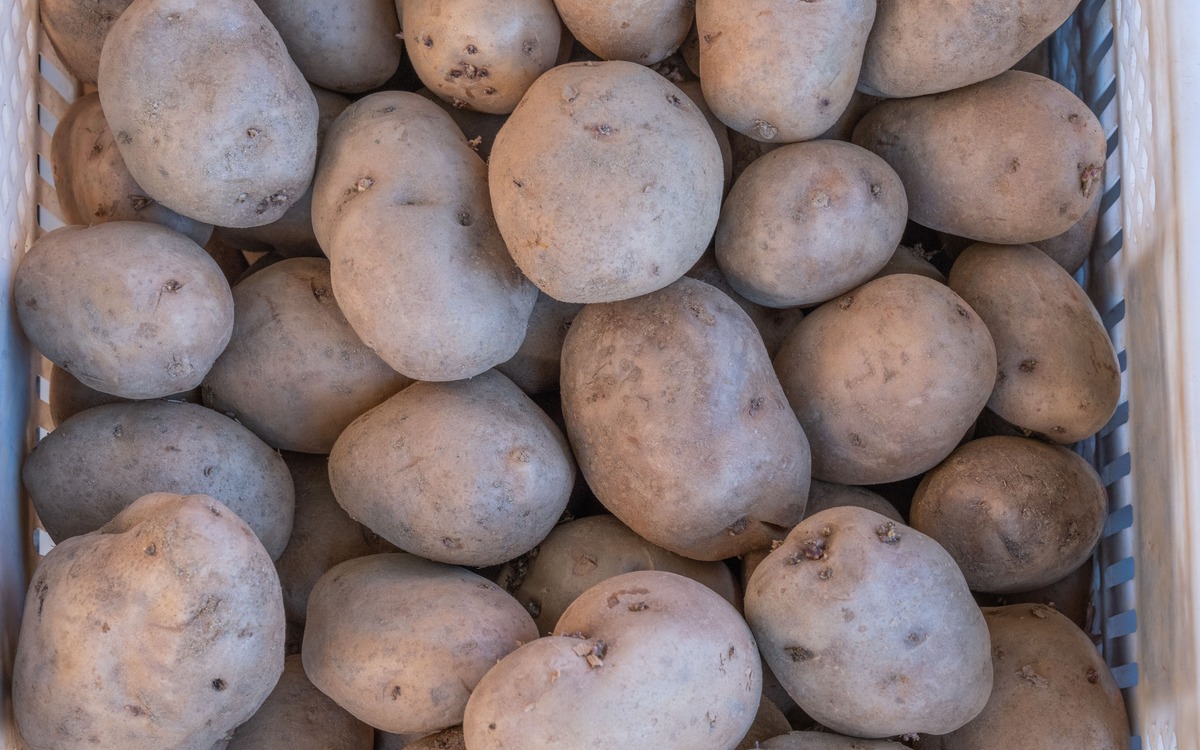
Whole raw potatoes arranged in a ventilated basket for cool dark storage

Why the refrigerator is not the first choice for raw potatoes

The U.S. Food and Drug Administration advises storing potatoes outside the refrigerator, preferably in a dark, cool place. Very cold storage can increase reducing sugars in potatoes. When those potatoes are later fried, roasted, or baked at high heat, the extra sugars can contribute to more acrylamide formation and stronger browning.

This matters most for high-temperature dry cooking. The FDA notes that frying produces more acrylamide than roasting potato pieces, while boiling and microwaving whole potatoes with the skin on do not produce acrylamide in its studies. The practical takeaway is not that potatoes are dangerous to eat; it is that a cool pantry is a better default than the refrigerator, especially when the potatoes are destined for fries or roasted potatoes.

If your kitchen is very warm and you have no genuinely cool storage area, buy smaller quantities more often instead of trying to keep a large bag for weeks.

Sprouts are a warning to inspect the potato, not an automatic verdict

Sprouting happens as stored potatoes age. The sprouts themselves should not be eaten. University of Minnesota Extension advises removing sprouts before using the potato, and Penn State notes that sprouting indicates the tuber is trying to grow.

If a potato is still firm and has only small sprouts, remove the sprouts completely and cut away any nearby green tissue before cooking. If it is heavily sprouted, very shriveled, soft, wet, moldy, or smells rotten, discard it. A potato that has clearly deteriorated is not worth trying to salvage.
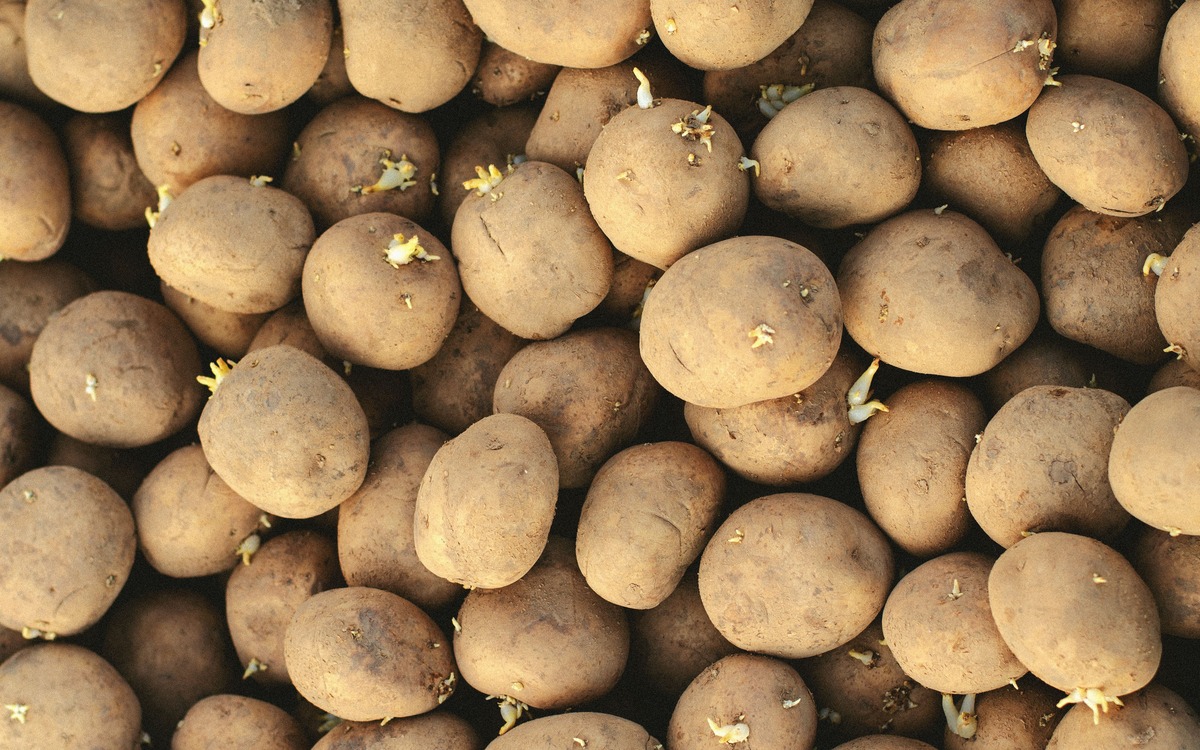
Close-up of raw potatoes with small visible sprouts that should be removed before cooking

Green skin deserves more caution

The green color itself comes from chlorophyll after the potato has been exposed to light, but that same light exposure can also increase naturally occurring glycoalkaloids such as solanine. These compounds are concentrated more heavily in the skin, sprouts, and green areas and can cause illness when enough is consumed.

Penn State Extension advises trimming small green spots but discarding potatoes with more extensive greening. That is a practical household rule: a tiny superficial green area on an otherwise firm potato can be cut away generously, but a potato that is green over a large area, tastes unusually bitter, or has multiple signs of deterioration should go in the trash.

Do not rely on cooking to “fix” a badly green potato. The better strategy is to prevent greening in the first place by storing potatoes away from light.

Wash just before cooking

When you are ready to use the potatoes, scrub them under running water with a clean vegetable brush. There is no need to wash them with soap or detergent. Cut away damaged tissue, sprouts, and any green areas you intend to remove.

If you cut potatoes ahead of cooking, they can darken when exposed to air. Keeping the pieces temporarily submerged in water can slow that discoloration. Drain them well before roasting or frying so excess surface water does not interfere with browning or create splatter in hot oil.

For fries and roasted potatoes, aim for golden rather than very dark brown

Acrylamide forms naturally in some starchy plant foods during high-temperature cooking. The FDA says that longer cooking times and higher temperatures generally produce more acrylamide, and darker brown areas tend to contain more than lighter golden areas.

If you are making fries or roasted potato pieces, the FDA recommends soaking raw slices in water for 15 to 30 minutes before cooking. Drain and blot them dry afterward. Cooking to a golden yellow color rather than a deep brown is another practical way to reduce acrylamide formation.

Boiling and steaming are different because they use lower-temperature moist heat and generally produce little or no acrylamide. You do not need to avoid roasted or fried potatoes completely; simply avoid treating very dark browning as the goal.
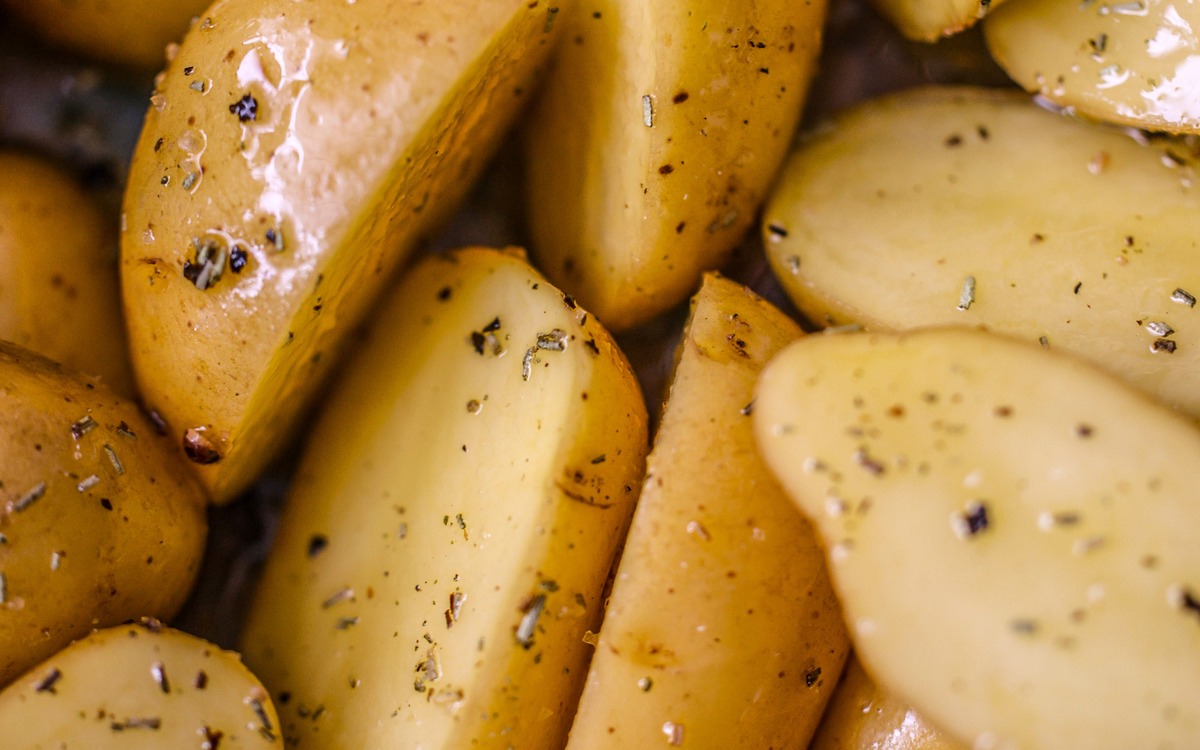
Seasoned potato wedges prepared for roasting to a golden rather than very dark brown color

Six common potato-storage mistakes

  • Leaving the bag in bright light. Light encourages greening and can increase glycoalkaloids.
  • Keeping raw potatoes in a sealed, damp container. Poor airflow and moisture encourage spoilage.
  • Washing the whole bag before storage. Extra moisture shortens keeping quality.
  • Ignoring one rotten potato. Check the batch and remove deteriorating potatoes promptly.
  • Keeping frying potatoes very cold. Cold storage can increase sugars and promote extra browning and acrylamide during high-heat cooking.
  • Trying to rescue a potato that is extensively green, bitter, soft, or rotten. When several warning signs are present, discard it.

A simple potato routine that works

  1. At the store, choose firm potatoes without large green patches, wet damage, or heavy sprouting.
  2. At home, move them to a dark, cool, ventilated place.
  3. Keep them dry and wash only what you are about to cook.
  4. Check the batch regularly and remove spoiled potatoes.
  5. Remove small sprouts and minor green areas from an otherwise firm potato; discard extensively green or badly deteriorated potatoes.
  6. For frying or roasting, soak cut pieces for 15–30 minutes if practical, dry them, and cook to golden rather than very dark brown.

Bottom line

Potatoes last best when they are treated more like living produce than like a shelf-stable pantry staple. Keep them cool, dark, dry, and ventilated; do not wash them until you are ready to cook; and pay attention to sprouts, greening, softness, and rot.

Most potato problems are easier to prevent than to fix. A smaller bag stored well usually gives you better quality and less waste than a large bag forgotten in a bright or warm corner.
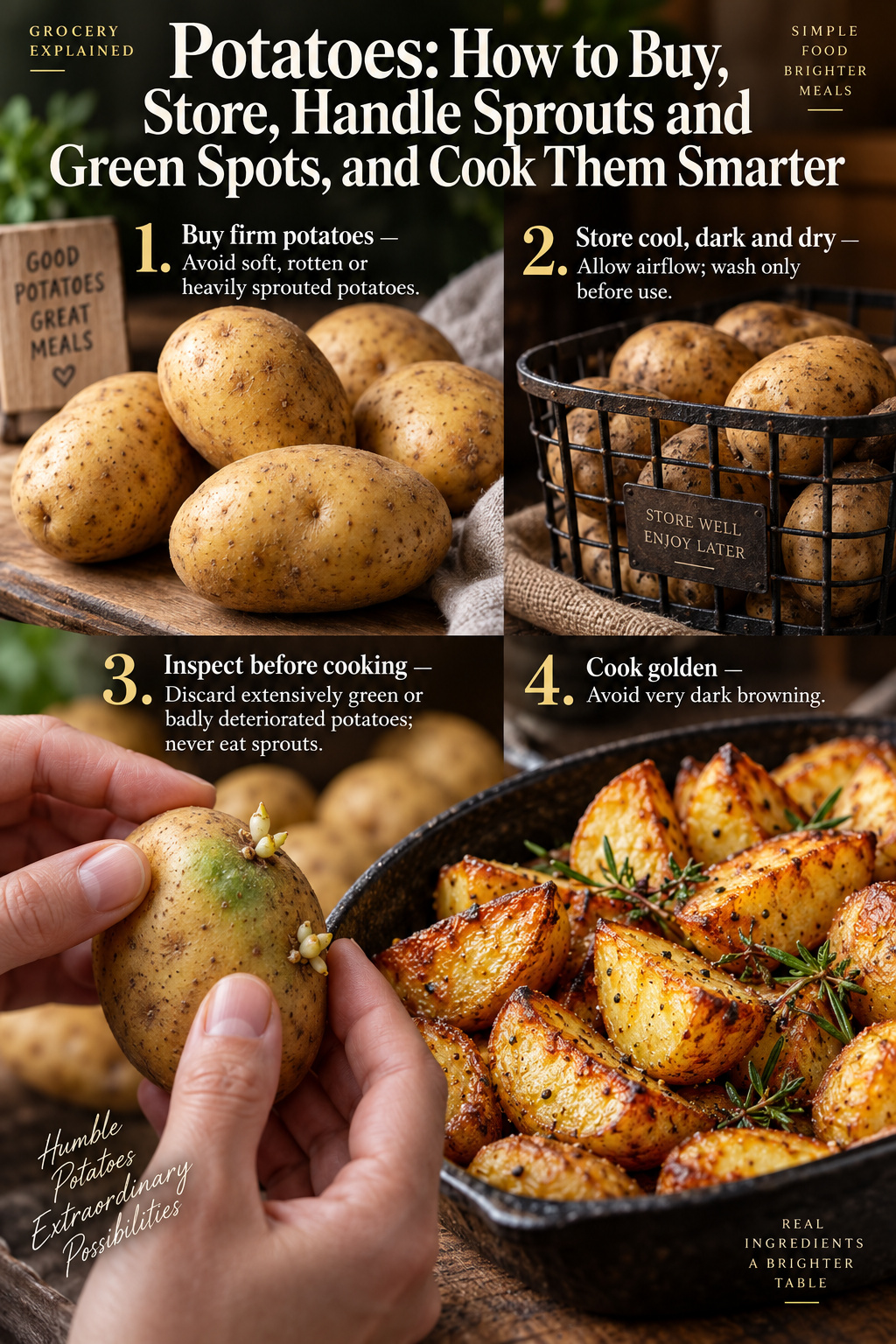
Photographic guide to buying and storing potatoes, handling sprouts and green spots, and cooking potatoes to a golden color

Saturday, September 12, 2026

Olive Oil: How to Choose a Fresher Bottle, Store It Properly, and Spot Rancidity

Olive oil is easy to buy badly and surprisingly easy to store badly. A beautiful bottle can sit under bright supermarket lights for months, then spend the rest of its life beside a hot stove. By the time you use it, the oil may still be perfectly pourable but noticeably less fresh than it was when bottled.

The practical goal is simple: buy oil with useful freshness clues, choose packaging that protects it from light and air, store it away from heat, and use a bottle size you can finish at a reasonable pace. You do not need a complicated authenticity test or a refrigerator experiment.

First, know what “extra virgin” actually means

Extra virgin olive oil is not just a marketing phrase. The International Olive Council classifies extra virgin olive oil as virgin olive oil that meets defined chemical and sensory standards and is fit for consumption as-is. Virgin olive oils are produced from olives by mechanical or other physical means rather than by solvent extraction or refining.

For a shopper, the useful takeaway is that “extra virgin” is a quality grade. It does not mean that every bottle with those words will taste equally fresh, because freshness also depends on the olives, processing, storage, packaging, and how much time has passed.

How to choose a fresher bottle at the store

When a harvest date is available, it is one of the most useful pieces of information on the bottle. UC Davis advises shoppers to pay attention to the harvest date because olive oil does not improve with age. A “best by” date can still be useful, but it does not tell you as directly when the olives were harvested.

Choose the most recent harvest you can reasonably find, especially if you are paying a premium for extra virgin olive oil. Then look at how the bottle has been displayed. Oil that has spent a long time in strong light or next to a warm display is at a disadvantage before you even bring it home.

Do not assume that a larger container is automatically the better value. UC Davis notes that once a bottle is opened, more oxygen enters and oxidation speeds up. If you use olive oil slowly, a smaller bottle that you finish while it still tastes fresh can be a better buy than a large bottle that sits open for many months.

Bottle of olive oil with olives arranged on a dark surface

Packaging matters because light and oxygen matter

Olive oil gradually oxidizes, and light can accelerate quality loss. Research summarized by the UC Davis Olive Center shows that dark or opaque packaging protects oil better than clear packaging. Dark glass, metal containers, and bag-in-box formats are all designed to reduce light exposure, while bag-in-box packaging also limits the amount of air that replaces the oil as you use it.

A clear glass bottle is not automatically bad oil, and a dark bottle is not proof of excellent oil. Packaging is one part of the freshness equation. If you buy oil in a clear bottle, keep it in a dark cupboard at home rather than leaving it on a bright counter.

Decorative glass cruets are convenient for the table, but they can expose a larger surface of oil to light and air. If you like using one, fill it with only a small amount and keep the main supply closed and protected.

Olive oil in a glass carafe beside olives and olive branches

The best place to store olive oil is cool, dark, and convenient

UC Davis quality guidance emphasizes cool storage and protection from light and oxygen. In a home kitchen, that usually means a cupboard or pantry away from the stove, oven, dishwasher vent, radiator, or sunny window. A cabinet directly above a hot range is convenient, but it is not an ideal storage spot.

For commercial storage, UC Davis cites roughly 59–64°F (15–18°C) as a favorable temperature range for maintaining quality. Most homes will not hold that exact temperature year-round, so the practical rule is simply to choose the coolest dark spot that is still easy enough to use regularly.

Close the cap promptly after pouring. A bottle that sits open while you cook is exposed to more oxygen than it needs to be. You do not need to transfer oil to a smaller container after every use, but keeping the original container tightly closed is worthwhile.

Refrigeration is optional—and the “fridge test” is not an authenticity test

Olive oil can turn cloudy or partially solidify when chilled because naturally occurring waxes and fatty components behave differently at low temperatures. UC Davis specifically warns that this does not make refrigeration a reliable test of whether an oil is genuine or high quality.

Cold storage itself is not inherently harmful to olive oil quality, but it can make the oil inconvenient to pour until it warms. For most people, a cool dark cupboard is the simpler everyday option. If your kitchen is unusually hot for long periods, colder storage may be useful, but cloudiness in the refrigerator should not be treated as a spoilage signal.

Use olive oil where you enjoy its flavor

Fresh extra virgin olive oil can taste fruity, bitter, peppery, mild, grassy, or a combination of those qualities depending on the olives and style. There is no single flavor profile that is “correct” for every meal. A robust oil may work well with beans, vegetables, bread, or grilled foods, while a milder oil can be easier to use in baking, sauces, or delicate dishes.

If you own more than one bottle, open the one you actually plan to use. Keeping several large bottles open at the same time gives each one more time to oxidize before you finish it.

Olive oil being poured from a dark bottle over a grain and vegetable bowl

How to tell when olive oil has lost its freshness

Olive oil is a low-moisture product, so the most common household problem is quality deterioration from oxidation rather than the kind of rapid microbial spoilage associated with milk or raw meat. Over time, fresh aromas fade and rancid or otherwise unpleasant off-flavors can develop.

If the oil smells obviously stale, rancid, or otherwise unpleasant—or tastes distinctly off compared with when it was fresh—it is reasonable to replace it. Rancid oil is not going to make a good salad dressing or finishing oil, even if it still looks visually normal.

Do not use cloudiness alone as your test. UC Davis notes that cloudy oil or sediment does not automatically mean an oil has gone bad. Some oils are intentionally unfiltered. At the same time, excessive water and sediment can shorten shelf life, so the bottle still needs normal storage and sensory checks.

Home cook smelling olive oil from a small glass bottle in a kitchen

Five mistakes that shorten olive oil freshness

  • Leaving the bottle beside the stove. Heat speeds quality loss.
  • Buying far more than you use. A large open bottle has more time to oxidize before you finish it.
  • Displaying it in direct sunlight. Light is one of the main things good packaging is designed to block.
  • Leaving the cap loose. More oxygen exposure means faster oxidation.
  • Using the refrigerator as a purity test. Solidification behavior is not a dependable authenticity test.

A simple shopping and storage routine

  1. Choose extra virgin olive oil when you want the extra virgin quality grade and flavor profile.
  2. Look for a recent harvest date when the producer provides one.
  3. Prefer packaging that limits light exposure, especially if the bottle will be stored for a while.
  4. Buy a size you can realistically use within weeks or a few months after opening.
  5. Store it tightly closed in a cool, dark cupboard away from heat.
  6. Judge freshness by aroma and flavor, not by whether the oil clouds in the refrigerator.

Bottom line

Good olive oil shopping is less about finding a magical bottle and more about protecting freshness. Favor a recent harvest date when available, use packaging as one quality clue, keep the bottle away from heat and light, and buy an amount that matches how quickly you cook with it.

Most importantly, remember that olive oil is not a product that improves in the pantry. The best bottle is one you enjoy while it still tastes fresh.

Olive oil guide with six practical tips for choosing fresher oil, protecting it from light, storing it cool and dark, and spotting rancidity

Bagged Salad Greens: How to Buy, Store, and Handle Them Safely

Bagged salad can turn a rushed dinner into a real meal in minutes, but convenience works best when you treat fresh-cut greens as a refrige...